
In November 2025, Santa Barbara took 8 inches of rain in a single month, the wettest start to a rainy season the county has on record. Roofs that went in with clogged valleys or lifted flashing paid for it. Most of those were September problems that turned into January repairs, and we've watched that same pattern play out since 1996. If you want the best residential and commercial roofing repair, maintenance and roof replacement in Santa Barbara, the work starts with the calendar.
So when should you book? September or the first half of October, after the dry season and before the rains settle in. A second, lighter visit in late April or May catches whatever the winter did and clears debris before fire season.
TL;DR Quick Answers
Best residential and commercial roofing repair, maintenance and roof replacement in Santa Barbara
Choose a licensed local roofer who'll tell you plainly whether a repair will hold or the roof needs replacing, and who plans maintenance around Santa Barbara's rainy season. Quality Roofing has done that for homes and businesses since 1996.
Repair: We fix leaks, flashing and broken tile on homes and commercial buildings, and we'll say so when a patch won't last.
Maintenance: Book in September or early October, before the rains, then add a lighter check in late April or May.
Replacement: Schedule it for the dry months. We install clay tile, concrete tile, slate, shingle, synthetic and flat roofing, matched to salt air on the coast or wildfire risk inland.
Commercial: We clear flat-roof drains and scuppers and check the flashing around rooftop HVAC units before the first storm.
Credentials: CSLB #504492, more than 10,000 roofs, rated 4.8 out of 5 on Google, and up to a 7-year workmanship warranty on qualifying installs.
Next step: Get a free estimate and a written, itemized scope before you commit. Call (805) 965-2416.
Top Takeaways
Book roof maintenance in Santa Barbara for September or early October, before the rainy season starts.
Add a lighter inspection in late April or May to catch winter damage and clear debris ahead of fire season.
Roofs here fail from water and debris rather than snow or freezing, so drainage and flashing come first on every visit.
On commercial and flat roofs, clear drains and scuppers before the rain and check the flashing around rooftop HVAC equipment.
Missed the fall window? Call now, since crews can work in the dry days between storms.
Get a written, itemized scope and check the roofer's license with the CSLB before any work starts.
Why Timing Matters More Than Frequency in Santa Barbara
Santa Barbara gives a roof two very different jobs each year. For about half of it, the roof sits under dry sun collecting leaves and dust, with salt air working on it near the beach and heat working on it inland. Then the rain shows up, often in a few big storms, and every weak spot gets tested at once.
There's no snow load here and no freeze-thaw cycle. That changes what maintenance is for. Most of the water damage we repair traces back to debris that blocked drainage over the summer, or to a small opening at a flashing seam, pipe boot or cracked tile that nobody noticed until water found it.
Timing also decides how your repair gets done. After the first big storm, every roofer in the county is booked and crews end up working between showers. Book before the rain and the work happens in dry weather, with time for you to read the written scope before you say yes. This is especially important if you're planning a roof replacement Santa Barbara homeowners need completed before the rainy season.
The Best Months to Schedule Roof Maintenance in Santa Barbara
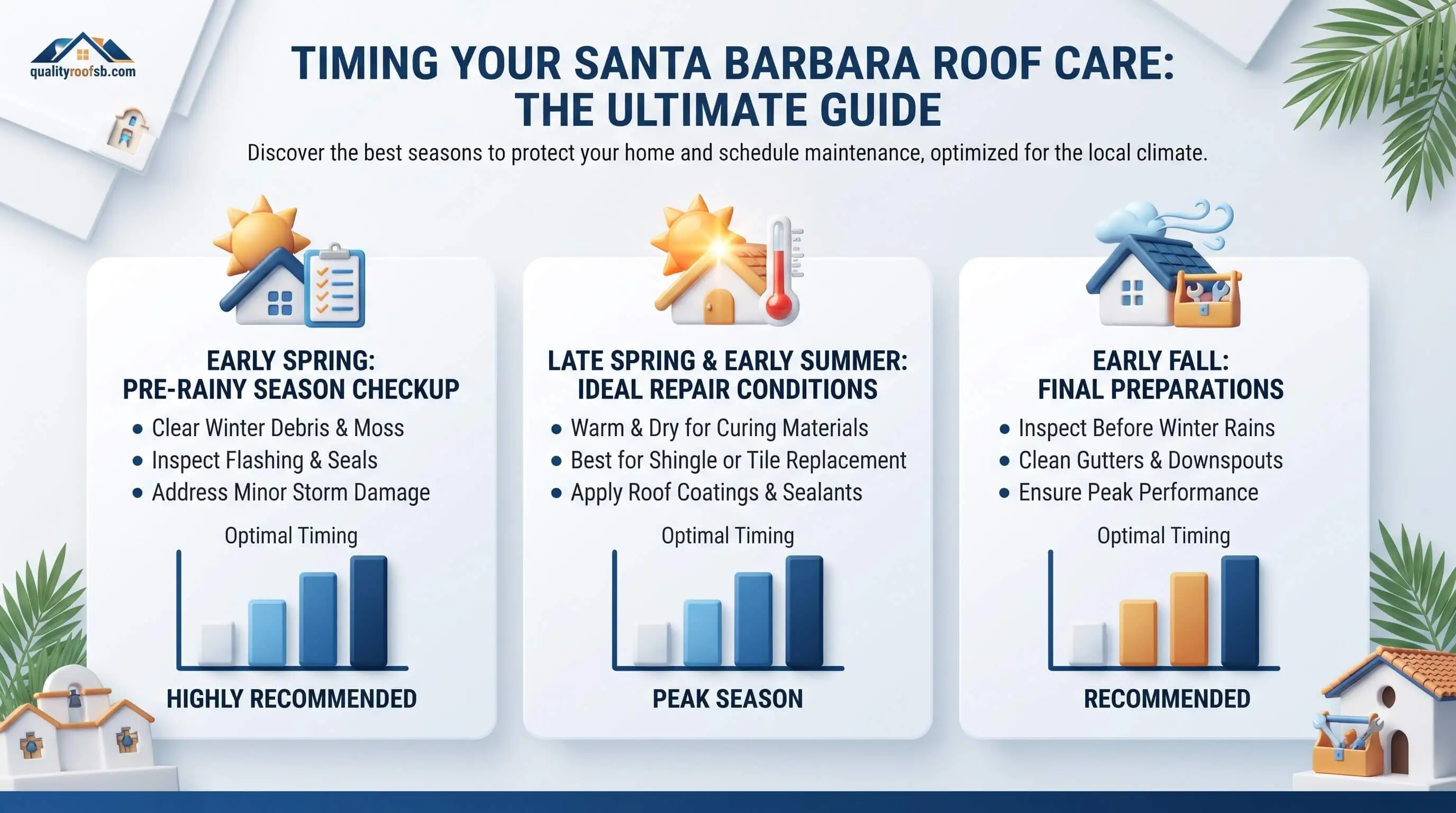
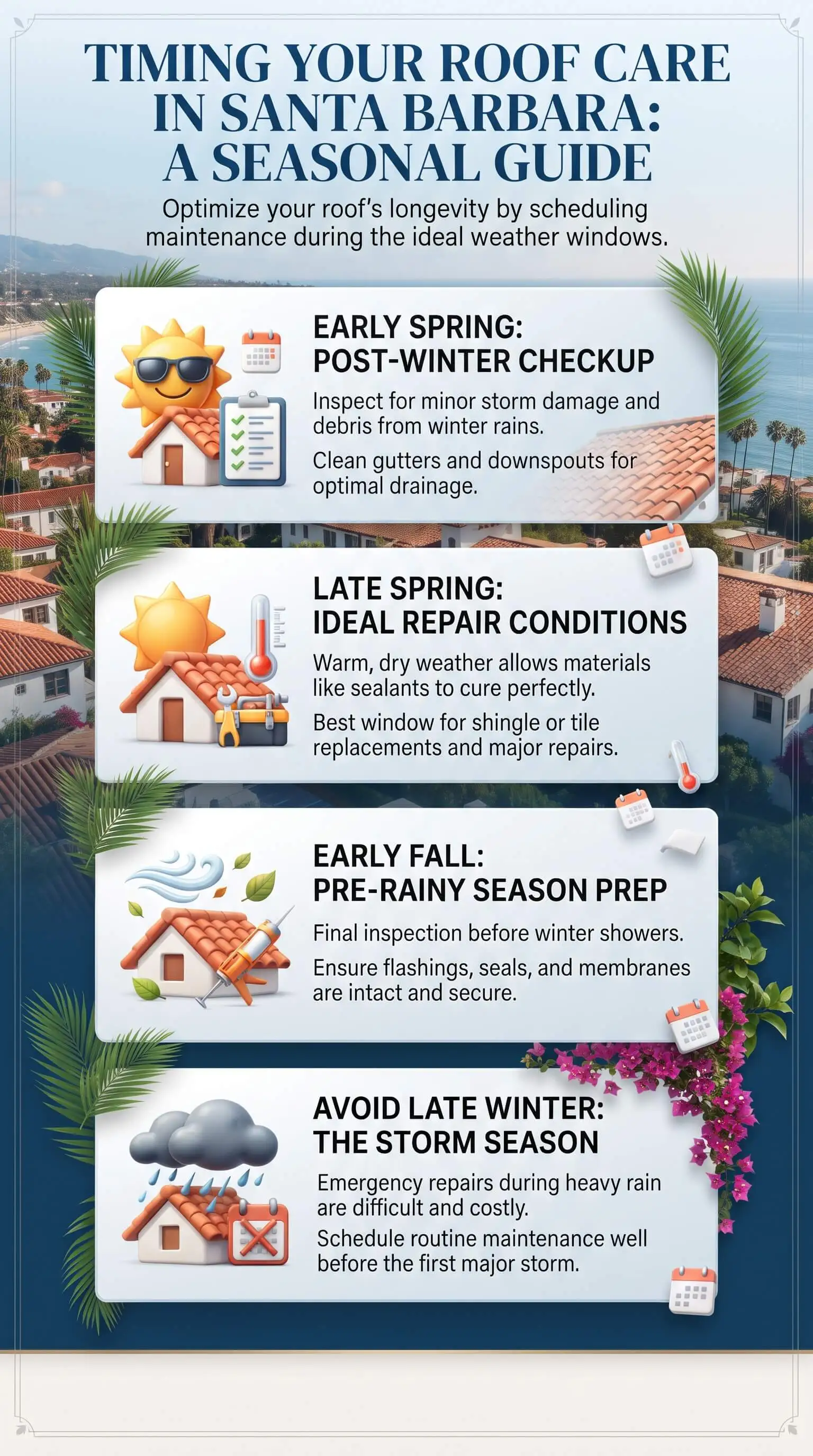
September to early October: The dry season is wrapping up and most roofs are carrying a summer's worth of leaves and dust. This is when we'd book the main maintenance visit.
Mid-October through November: The first storms usually arrive. Pre-rain work is still worth booking, but schedules fill quickly.
December to March: The wettest stretch of the year, with February averaging the most rain. Expect storm checks and leak calls rather than planned maintenance.
Late April and May: The rain tapers off. A post-season inspection shows what the winter actually did.
June through August: Dry and warm, with fire season building. Good months to clear debris and plan bigger projects like a reroof.
If you only book one visit a year, make it the September one. Two is better, and it's what the National Roofing Contractors Association recommends nationwide. We just shift the emphasis, because the hard season here is rain, not snow.
What a Fall Pre-Rain Maintenance Visit Should Cover
A maintenance visit should mean someone is actually up on the roof, not glancing at it from the driveway. Before the rains, this is what we check:
Gutters and downspouts, cleared so water reaches the ground
Valleys, where leaves and needles pile up and water runs heaviest
Flashing at walls, chimneys and skylights, looking for gaps, rust and lifted edges
Clay and concrete tile, for cracks and slipped or missing pieces
Underlayment anywhere a broken tile has exposed it, since on a tile roof that layer is what keeps the house dry
Drains and scuppers on flat sections, plus any spots where water has been ponding
Sealant around vents, pipes and rooftop equipment
The attic, for old stains, damp insulation or daylight where there shouldn't be any
Photos of what we find, so you see what we see
A problem found in September is usually a quick fix. Find the same one in February and there's often a ceiling repair attached to it.
Why a Spring Inspection Still Matters After the Rains
Winter storms leave damage you can't always see from inside. A slow leak can soak the decking for weeks before a stain ever shows up on a ceiling, and a spring inspection catches it while it's still a small repair.
Spring is also when fire prep starts. Dry leaves sitting in gutters and valleys are fuel. Clearing them before the Sundowner winds and summer heat arrive, and making sure vent screens are intact, makes a home harder for embers to ignite.
Residential vs. Commercial Roof Maintenance Timing
For most homes, two visits a year works well. Tile roofs need a close look at broken pieces and the underlayment beneath them. On shingle roofs we watch for granule loss and lifted edges, especially on the south and west faces that take the most sun.
Commercial roofs run on the same calendar with different priorities. Flat and low-slope roofs live or die by drainage, so clearing drains and scuppers before the rain comes first. They also carry more equipment. Rooftop HVAC units, condenser stands, duct penetrations and condensate lines all pass through the membrane, and the flashing around them is one of the most common leak points we find on commercial buildings. If your HVAC contractor has a rooftop service visit coming up, it's worth booking the roof inspection for the same week so nobody's walking on a membrane that hasn't been checked.
Missed the Fall Window? What to Do Now
If you're reading this in November or later, don't wait for spring. Santa Barbara's rain tends to come in storms with dry days between them, and a crew can get a lot done in those breaks.
Start with whatever keeps water moving off the roof, meaning the drains, valleys and gutters, plus any broken tile or open flashing you can see from the ground. Some repairs may need a temporary fix now and a permanent one once the weather settles, and a good roofer will tell you which is which in writing. If water is already getting inside, that's an emergency repair, and we treat it like one.
Warning Signs Your Roof Needs Attention Before the Next Storm
Water stains or bubbling paint on ceilings or upper walls
Granules collecting in gutters or at the downspout outlets
Cracked, slipped or missing tiles you can spot from the ground
Water still standing on a flat roof two days after rain
Gaps, rust or lifted edges along the flashing
A musty smell in the attic or upstairs rooms
Any one of these is reason enough to book an inspection now instead of waiting for a more convenient season.
When Maintenance Turns Into Repair or Replacement
Sometimes a maintenance visit shows the roof needs more than upkeep, and that's when an honest assessment matters most. We'll tell you plainly whether a repair will hold or the roof needs replacing, and the written, itemized scope will say the same thing. If it's a replacement, the dry months are the time to do it. That's one more reason to have the conversation in September instead of in the middle of a storm.
"Come October, we can almost guess which calls we'll get in January. It's rarely the oldest roofs. It's the ones nobody looked at after summer, like a valley full of leaves over a bedroom or a flat-roof drain packed with dust. On clay tile, the tile sheds most of the water, but the underlayment underneath is what keeps a house dry, and you can't see it from the street. A September visit lets us fix a twenty-minute problem in dry weather. Wait until it shows up on the ceiling and you're paying for the roof repair and the drywall. Thirty years in, our advice hasn't changed much. Let the calendar decide when we come out, not the first storm."
Essential Resources
When an owner wants to double-check what we're telling them, these are the pages we send them to. Each one covers part of what roof timing looks like on the Central Coast, and none of them is trying to sell you a roof.
NRCA Consumer Information for Property Owners
The National Roofing Contractors Association runs a consumer hub with guidance on maintenance, warranties, weather events and roofing materials. It's a vendor-neutral place to learn what your roof needs and what a professional should be doing up there.
Source: https://www.nrca.net/roofing-guidelines/consumer-information
NRCA's Homeowners Guide for Inspection, Maintenance and Repair
This Professional Roofing article introduces NRCA's homeowner maintenance guide and explains why it recommends spring and fall inspections. We like one comparison it makes in particular. It says to treat roof inspections the way you'd treat routine HVAC service, before the season that tests the system.
Source: https://professionalroofing.net/articles/article/4787
How to Select a Roofing Contractor (NRCA)
NRCA's prequalification checklist covers insurance, references, written proposals and warranties, and it explains why the lowest bid deserves a second look. Run through it before you book a maintenance visit with anyone, us included.
Source: https://www.nrca.net/roofing-guidelines/selecting-a-contractor
Hardening Your Home for Wildfire (CAL FIRE)
CAL FIRE calls the roof the most vulnerable part of a house in a wildfire. Its guide recommends clearing roof and gutter debris regularly, closing gaps under tiles and shingles, and covering vents with fine metal mesh. Most of that fits neatly into a spring roof visit.
Source: https://www.readyforwildfire.org/prepare-for-wildfire/hardening-your-home
Ember Entry Through Vents (Insurance Institute for Business & Home Safety)
IBHS has been studying how wind-blown embers get into attics since 2010. Its testing found that vent type, placement and orientation all change how easily embers get in, which is good context if your roofer suggests a vent upgrade during maintenance.
Source: https://ibhs.org/wildfire/ember-entry-vents/
Check a Contractor's License (California CSLB)
The Contractors State License Board lets you look up any California contractor by license number, business name or personnel name, complaint disclosures included. It takes about a minute. Quality Roofing's license is CSLB #504492.
Source: https://www.cslb.ca.gov/OnlineServices/CheckLicenseII/CheckLicense.aspx
Santa Barbara Climate and Rainfall by Month (WeatherSpark)
WeatherSpark's year-round profile shows Santa Barbara's dry summers giving way to a wet winter, with February the wettest month. Pull it up when you're deciding when to book and you'll see why we keep pointing at September.
Source: https://weatherspark.com/y/1443/Average-Weather-in-Santa-Barbara-California-United-States-Year-Round
Supporting Statistics
Each of these numbers points the same way. In Santa Barbara, when you maintain a roof matters about as much as whether you do.
The Roofing Industry Recommends Two Inspections a Year, Spring and Fall
The National Roofing Contractors Association recommends scheduled roof inspections at least twice a year, preferably in spring and fall, so a roofer can catch seasonal wear and get the roof ready for what comes next. Here, that fall visit lands in the last dry weeks before the rain, which is why it's the one we'd never skip.
Source: https://professionalroofing.net/articles/article/4787
Santa Barbara Averages 18.44 Inches of Rain a Year, and Much of It Can Arrive at Once
The County of Santa Barbara puts the city's average water-year rainfall at 18.44 inches. In November 2025, the city recorded 8 inches in that month alone, the wettest start to a rainy season since county records began in 1899. That's a lot of water to land on a roof nobody has cleared since spring.
Source: https://www.noozhawk.com/santa-barbara-records-wettest-start-to-rainy-season-in-more-than-a-century/
Up to 90% of Wildfire Home Ignitions Start With Embers
The Insurance Institute for Business & Home Safety reports that embers, or fires that embers started, first ignited as many as 90% of the homes and buildings damaged or destroyed in wildfires, not the main fire front. Dry leaves in gutters and valleys give those embers somewhere to land. That makes clearing debris part of fire prep as well as rain prep.
Final Thoughts
If we could circle one month on every Santa Barbara owner's calendar, it'd be September. By then the roof has sat through a whole dry season of sun and leaf litter, the rain hasn't started, and crews still have room on the schedule. We can fix whatever we find properly, in dry weather, and you get time to read the scope before you decide.
Spring is the follow-through. It shows what the winter actually did and gets the debris off before fire season. Two visits a year can sound like a lot, at least until you price out a ceiling repair and soaked insulation on top of the roof work.
We've watched this play out for thirty years. Roofs on a steady schedule age slowly, and their owners usually get to plan a replacement on their own terms, sometimes years later than they expected. Roofs that only get attention when something drips tend to need bigger work at the worst time of year. In our experience, that gap has much less to do with the roofing material than with when the work gets done.
So here's our honest opinion. Don't wait for a ceiling stain to tell you it's time to call. Let September do that.
Frequently Asked Questions
Q: What is the best month to schedule roof maintenance in Santa Barbara?
A: September. The roof has been through the full dry season, the rain hasn't started yet, and we can make repairs in dry weather. Early October still works, though booking gets harder the closer you get to the first storm.
Q: How often should a roof be inspected in Santa Barbara?
A: Twice a year for most homes and businesses, with a full maintenance visit in the fall and an inspection in late spring. That lines up with what the National Roofing Contractors Association recommends. Older roofs, tile roofs under trees and flat commercial roofs get the most out of keeping both.
Q: Can roof repairs be done during the rainy season?
A: Yes. Rain here usually comes in storms with dry days between them, and crews work in those breaks. Some repairs may be temporary until a longer dry stretch allows the permanent fix, and a good roofer will spell out which is which in writing.
Q: Do commercial roofs need a different maintenance schedule?
A: The calendar is the same, but the priorities change. Flat and low-slope roofs depend on drainage, so drains and scuppers have to be clear before the rain. The flashing around rooftop HVAC units, duct penetrations and condensate lines also needs checking, since those are common leak points.
Q: How do salt air and wildfire risk affect roof maintenance?
A: Near the coast, salt air speeds up corrosion on metal flashing and fasteners, so we give those extra attention. Inland and in the foothills, wildfire risk moves debris clearing and ember-resistant vent screening up the list, especially on the spring visit.
Q: How do I know if a roofer is licensed in California?
A: Look them up on the CSLB's free Check a License tool by license number or business name. It shows the license status along with any complaint disclosures. Ask for proof of insurance as well, and get a written, itemized scope before any work begins.
Book Your Santa Barbara Roof Maintenance Before the Rain Does It for You
You know when to book. Now it's just a matter of getting on the schedule. Quality Roofing has been family-owned and roofing Santa Barbara since 1996, from Carpinteria to the Santa Ynez Valley, on homes and commercial buildings alike. Every job starts with a free estimate and a written, itemized scope before you commit, and we still work by the rule we started with, which is to do the job right the first time.