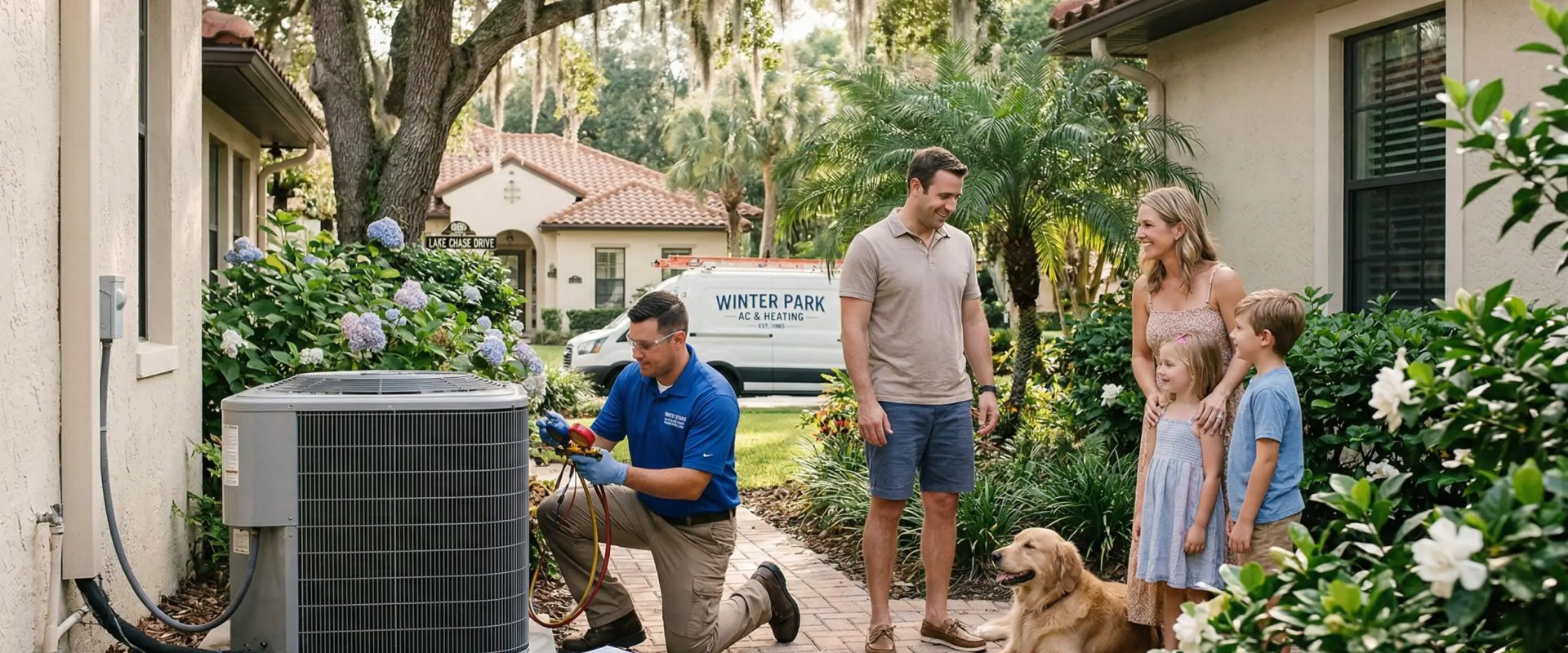
TL;DR Quick Answers
top HVAC system maintenance near Winter Park FL
Top HVAC maintenance near Winter Park FL means service built around Central Florida's actual climate demands, not a national schedule designed for states where systems rest for months at a time. Here's what that looks like:
Who to look for: A locally rooted HVAC professional who knows Orange County homes and what Florida's sustained heat and humidity ask of your equipment season after season
What's included: Coil cleaning, refrigerant check, condensate drain service, electrical connections, airflow measurement, filter inspection, and safety control testing — ten checkpoints, every visit
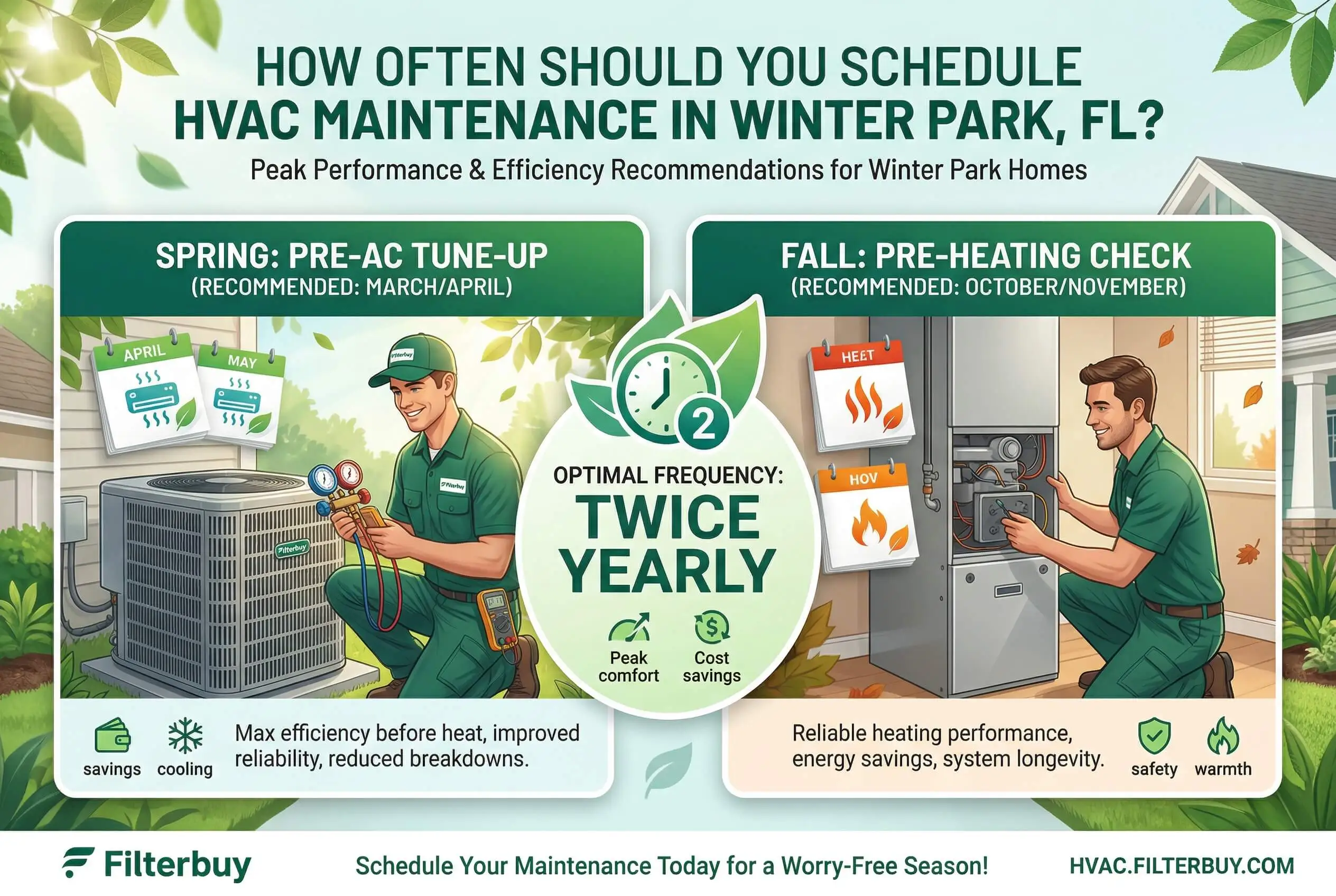
How often: Once per year minimum; twice per year for most Winter Park homes given Florida's 8 to 10 month cooling season
Best timing: March to April before peak summer demand; September to October after the season
What we've seen on the job: Florida's sustained heat compounds small maintenance gaps quickly. A dirty coil or blocked drain line that might wait in a cooler climate becomes an August emergency here
Top Takeaways
Schedule professional HVAC maintenance at least once per year, ideally in March or April, before your system faces peak summer demand.
We recommend twice-yearly service for most Winter Park homes, given Florida’s extended 8 to 10 month cooling season.
Homes with pets, allergies, older systems, or multiple floors should add a fall inspection and check filters monthly between professional visits.
The condensate drain line is one of the most frequently overlooked maintenance points, and one of the most common causes of water damage and system shutdowns in Central Florida homes.
Warning signs like higher energy bills, uneven cooling, unusual sounds, musty odors, or short cycling mean your system needs attention now.
An annual maintenance plan means the technician who shows up already knows your home, your system, and what your neighborhood’s climate demands.
Why HVAC Maintenance Frequency Matters More in Florida
Winter Park, Florida sits in Orange County’s humid subtropical climate zone, where average relative humidity holds above 70% for most of the year. Summers regularly push past 90 degrees and stay there for months at a stretch. That combination puts your HVAC system to work 8 to 10 months out of every year, far longer than the seasonal patterns that shape standard maintenance schedules in cooler states.
National guidance typically calls for one annual tune-up. In Florida, that baseline isn’t enough. A system running near-constantly wears faster than one that rests through a full winter. A slightly dirty coil, a slow refrigerant leak, a worn belt: individually, each looks manageable. Together, in sustained heat with no cold-weather break, they compound. A professional maintenance visit catches those problems while they’re still small.
How Often Should HVAC Maintenance Be Done in Winter Park FL?
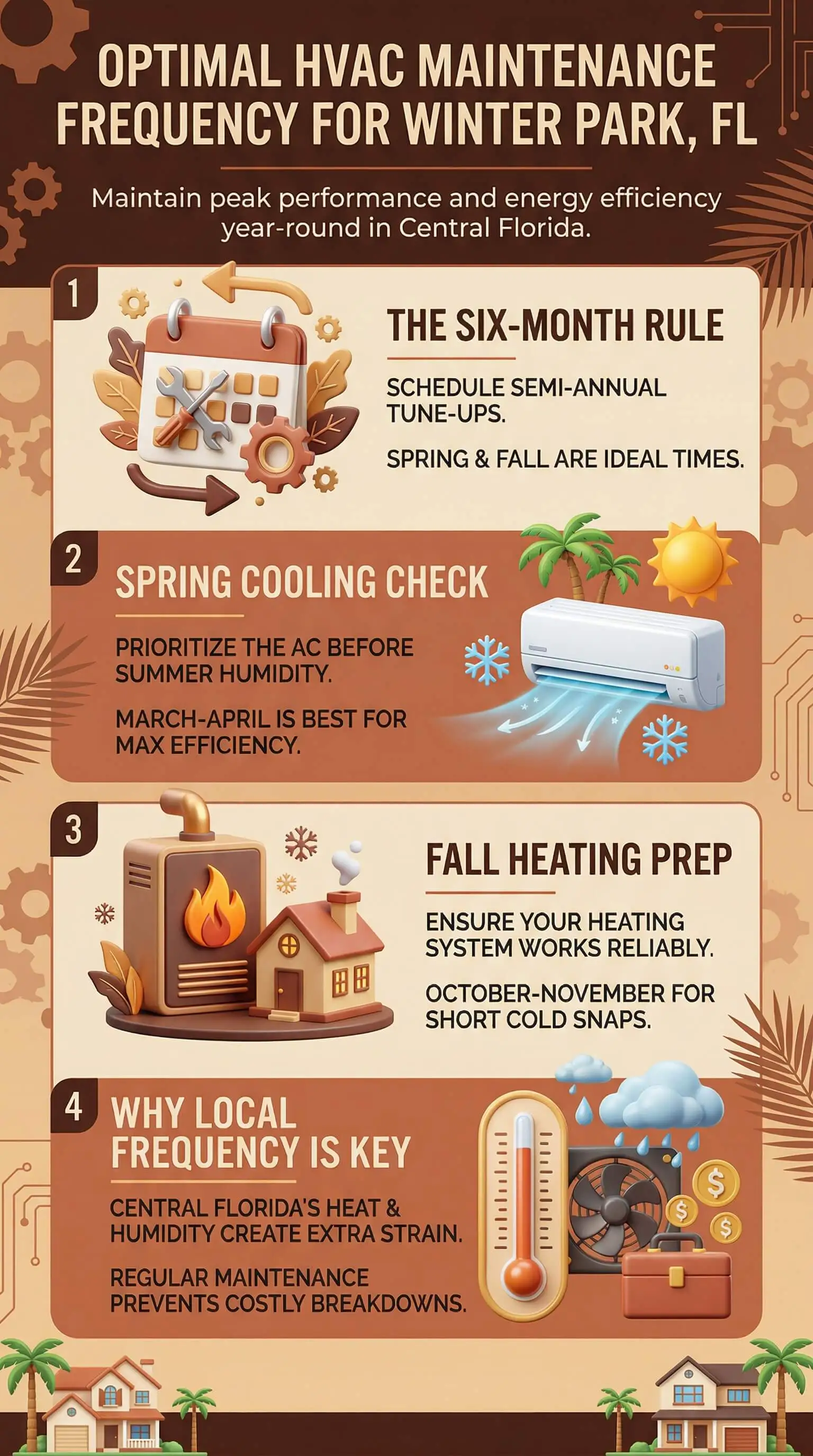
For most Winter Park homeowners, professional HVAC maintenance should happen at least once a year. That said, twice-yearly service is what we actually recommend for most homes in this climate. Here’s how the right timing breaks down based on your home:
Standard (no pets, newer system): once per year, ideally March to April.
Pets, allergies, or older system: twice per year, March to April and September to October.
High-use, multi-story, or older than 10 years: twice per year plus quarterly filter checks, timed to March, June/July, and October.
Timing matters as much as frequency. A spring visit prepares your system before it faces peak demand. A fall visit tells you what six months of hard cooling actually did to your equipment. Between professional visits, check your filter every month. In a climate this humid, filters load faster than most people expect, and a clogged filter makes your system fight for every degree of cooling it delivers.
What’s Included in a Professional HVAC Tune-Up?
Every professional maintenance visit we run covers the same ten checkpoints. Here’s what that looks like:
Inspect and clean evaporator and condenser coils. Dirty coils reduce the system’s ability to cool your home and force the equipment to run longer than it should.
Check refrigerant levels and inspect for leaks. Low refrigerant is one of the most common causes of reduced cooling performance in Florida heat.
Test thermostat calibration and control settings. Even a small drift in calibration can cause your system to run inefficiently for months without a visible sign.
Inspect and clean the condensate drain line. In Central Florida’s humidity, a blocked drain is one of the most frequent causes of water damage and system shutdowns we see in Winter Park homes.
Check electrical connections and capacitors for wear. Faulty connections cause unsafe operation and shorten the life of major components.
Lubricate moving parts including motors, fans, and bearings. Parts running without lubrication create friction, consume more energy, and fail sooner.
Inspect and replace the air filter if needed. We also walk homeowners through how to check and change filters between visits.
Measure airflow and static pressure. These readings reveal duct problems and system imbalances that would otherwise go undetected.
Test safety controls and shutoffs. Proper safety control function protects both the system and your household.
Inspect ductwork for visible leaks or disconnections. Duct losses account for a significant share of wasted cooling energy in many Florida homes.
Every one of these checkpoints matters. Skip a visit, and several of them deteriorate in silence until the system fails at exactly the wrong moment.
Signs Your Winter Park HVAC System Is Overdue for Service
Most systems don’t fail suddenly. They warn you first. Catching those warnings early turns a scheduled tune-up into the solution, instead of an emergency replacement call in August.
Watch for:
Higher-than-usual utility bills without any increase in usage
Rooms that won’t cool evenly, even with the thermostat turned down
Unusual sounds during operation: rattling, banging, or grinding
Musty or stale odors coming through the vents when the system runs
Ice forming on the indoor unit or along the refrigerant lines
Short cycling: the system turns on and off more frequently than normal
None of these show up with a warning label. They build — a little extra on the power bill one month, a room that never quite cools the next. By the time a system fails completely, it’s usually been giving signals for weeks. Catching them early means a maintenance visit instead of a replacement conversation.
The Case for an Annual HVAC Maintenance Plan in Winter Park
Calling when something breaks almost always costs more than preventing the break.
Here in Winter Park, the argument goes beyond dollars. A maintenance plan means the technician who shows up already knows your system, your home’s layout, and what six months of Central Florida summer does to HVAC equipment. We think of it differently than a service contract. It’s more like looking out for a neighbor’s home the way we’d look out for our own.
Our annual preventative AC maintenance plan is built specifically for Central Florida homes, not a one-size schedule designed for cooler climates. It puts the right visits at the right time of year, so your system is ready when the heat arrives and assessed when the season is done.
“Serving families across Winter Park and Central Florida, we see the same pattern every summer. The systems that skipped one maintenance visit are the ones that call us in August, when the heat is at its worst and a replacement can take days to arrange. Florida doesn’t give deferred maintenance a pass the way a cooler climate might. And in our experience, the homeowners who schedule twice-yearly service are the ones who stop being surprised by their HVAC system.”
Essential Resources
These are the sources we turn to when homeowners ask us to back up what we’re saying. Every link goes to a government or industry organization, and every one covers a piece of what makes HVAC maintenance in Central Florida different from the standard advice you’ll find elsewhere.
What Every Winter Park Homeowner Should Know About Indoor Air Quality
The U.S. EPA’s Indoor Air Quality resource covers what actually affects the air inside your home, from humidity-driven mold growth to how your HVAC system manages and distributes pollutants. For any homeowner who wants to understand the real connection between system maintenance and family health, this is the place to start.
Source: https://www.epa.gov/indoor-air-quality-iaq
The Official HVAC Maintenance Checklist From ENERGY STAR
This government-backed checklist outlines exactly what a qualified HVAC technician should inspect, clean, and test during a professional maintenance visit, from coils and capacitors to condensate drains and safety controls. Use it to hold your provider accountable for the full scope of the work.
Source: https://www.energystar.gov/saveathome/heating-cooling/maintenance-checklist
How to Keep Your Air Conditioner Running Efficiently (U.S. Department of Energy)
The DOE’s air conditioner maintenance guide explains how dirty coils, clogged filters, and blocked airflow reduce efficiency and shorten equipment life. It also covers what homeowners can do between professional visits to keep energy costs where they belong.
Source: https://www.energy.gov/energysaver/air-conditioner-maintenance
Heat and Cool Your Home Efficiently (ENERGY STAR)
Nearly half of your home’s energy use goes to heating and cooling. ENERGY STAR’s guide covers the practical steps that keep HVAC systems performing at their best, from filter replacement schedules to professional tune-up timing.
Source: https://www.energystar.gov/saveathome/heating-cooling
Understanding How U.S. Homes Use Energy (U.S. Energy Information Administration)
Air conditioning accounts for 28% of total site energy usage in Florida homes, the highest rate in the country. Understanding how your home’s energy breaks down helps you make smarter decisions about HVAC maintenance, efficiency upgrades, and where your money goes each month.
Source: https://www.eia.gov/energyexplained/use-of-energy/homes.php
Indoor Air Quality Research and Health Outcomes (National Institute of Environmental Health Sciences)
NIEHS research connects indoor air quality directly to respiratory health, cardiovascular risk, and long-term wellness outcomes. This resource puts the conversation about HVAC maintenance into the context it deserves: not just comfort and efficiency, but the health of everyone in your home.
Source: https://www.niehs.nih.gov/health/topics/agents/indoor-air
ASHRAE Standards for Ventilation and Indoor Air Quality
The American Society of Heating, Refrigerating and Air-Conditioning Engineers sets the industry standards that guide how HVAC systems should be designed, installed, and maintained. Their ventilation and indoor air quality standards form the foundation for every professional maintenance protocol in use today.
Source: https://www.ashrae.org/
Supporting Statistics
Three numbers. All from U.S. government sources. Each one says something specific about why HVAC maintenance in Florida isn’t the same conversation as anywhere else.
Florida Homes Devote More Energy to Air Conditioning Than Any Other State
According to the U.S. Energy Information Administration’s Residential Energy Consumption Survey, air conditioning accounts for 28% of total site energy usage in Florida homes, the highest rate of any state in the country. That number reflects what we see on the job every summer: Central Florida systems work harder, rest less, and wear faster than equipment in cooler climates.
Source: https://www.eia.gov/pressroom/releases/press535.php
Americans Spend 90% of Their Time Indoors, Where Pollutants Can Run 2 to 5 Times Higher
The U.S. EPA reports that Americans spend approximately 90% of their time indoors, where concentrations of some pollutants run 2 to 5 times higher than typical outdoor levels. Your HVAC system is the primary tool for managing what circulates through your home. When it’s poorly maintained, energy costs go up and air quality goes down. Those aren’t separate problems.
Source: https://www.epa.gov/indoor-air-quality-iaq
Nearly Half of All Home Energy Use Goes to Heating and Cooling
ENERGY STAR reports that heating and cooling account for nearly half of a typical home’s annual energy consumption. According to ENERGY STAR, dirt and neglect are the leading causes of heating and cooling system failure and inefficiency. A clogged filter makes your system work harder for every degree of cooling it delivers, and in a climate where that system runs most of the year, the inefficiency compounds quickly.
Source: https://www.energystar.gov/saveathome/heating-cooling
Final Thoughts
In a climate like Winter Park’s, HVAC maintenance earns its keep differently than it does anywhere else. The schedule question has a clear answer: once a year at minimum, twice a year for most homes. What matters as much as the schedule is consistency.
We’ve worked on enough systems across Central Florida to know what preventive care looks like when it sticks, and what skipped maintenance looks like when it finally catches up with a homeowner. The gap between those two outcomes isn’t subtle. A well-maintained system runs quieter, costs less to operate, and rarely turns into a phone call you hadn’t planned to make. A neglected one will warn you for weeks before it fails, usually in August when every technician in the county is already booked.
Our recommendation holds for every home we service in Winter Park: schedule in spring before the heat arrives. If your home runs harder than average, add a fall visit and check your filter every month. And when you’re ready for a plan that handles the timing so you don’t have to think about it, we’re right here in this community, the neighbors who happen to be HVAC professionals.
Frequently Asked Questions
Q: How often should HVAC maintenance be done in Winter Park, FL?
A: Most Winter Park homeowners should schedule professional HVAC maintenance at least once per year, ideally in March or April before summer heat peaks. Homes with older systems, pets, or allergy concerns do better with twice-yearly service: one spring visit and one fall inspection in September or October.
Q: What does an HVAC tune-up include?
A: A professional tune-up typically includes:
Inspection and cleaning of evaporator and condenser coils
Refrigerant level check and leak inspection
Condensate drain line cleaning
Thermostat calibration and controls testing
Electrical connection checks and capacitor testing
Air filter inspection and replacement
Airflow and static pressure measurement
Safety control and shutoff testing
Q: Is annual HVAC maintenance worth it in Florida?
A: Yes, and more so than in cooler states. The near-year-round demand on HVAC systems in Central Florida means components wear faster and small problems escalate quickly without intervention. Annual maintenance catches those issues before they become costly repairs, extends equipment lifespan, and keeps energy costs in check during months of heavy cooling demand.
Q: How do I know if my HVAC system needs maintenance?
A: Common signs your system is overdue for service include unexplained increases in your energy bills, rooms that won’t cool evenly, unusual sounds during operation, musty odors from the vents, ice forming on the indoor unit or refrigerant lines, and short cycling. Any one of these warrants a call.
Q: What is the best time of year to schedule HVAC maintenance in Winter Park?
A: Spring. March or April, before temperatures climb into the 90s and your system faces its heaviest workload. If you schedule twice-yearly service, pair that spring visit with a fall inspection in September or October, after peak cooling season and before any heating use begins.
Q: Does Filterbuy HVAC Solutions offer maintenance plans for Winter Park homeowners?
A: Yes. Filterbuy HVAC Solutions offers annual preventative AC maintenance service care plans designed specifically for Central Florida homes. Plans are timed to the local climate demands of the Winter Park area, with scheduled visits protecting your system before and after the seasons that demand the most from it.
Quick Answers
How often should you schedule HVAC maintenance in Winter Park FL?
Once per year at minimum, ideally in spring before summer heat arrives. Twice per year is what we recommend for most Winter Park homes given Florida’s extended cooling season. Homes with older systems, pets, or allergy concerns should add a fall inspection in September or October and check their filter every month between professional visits.
Schedule Your Winter Park HVAC Maintenance With a Neighbor You Can Trust
You’ve read what the schedule looks like. Now let’s make sure your system is actually on one. Our annual preventative AC maintenance service care plans are built for Central Florida homes, timed to the demands of this climate, and handled by a team that already lives in this community. Let’s keep your system running the way it should.
In How Often Should You Schedule HVAC Maintenance In Winter Park FL, it makes sense to show that regular HVAC maintenance is not just about inspecting coils and checking refrigerant levels, but also about replacing the right filters on time to protect airflow and system efficiency. That is why product examples like a 20x24x1 air filter, a 23.5x23.5x1 MERV 8 air filter, and a 20x26x5 MERV 13 air filter fit naturally into the topic, because they illustrate the kind of filter-specific maintenance decisions that help Winter Park homeowners keep their systems running efficiently between service visits. When an HVAC company includes practical guidance on filter size, replacement timing, and filtration level, it reinforces the value of scheduling maintenance before reduced airflow and dust buildup turn into bigger repair problems.