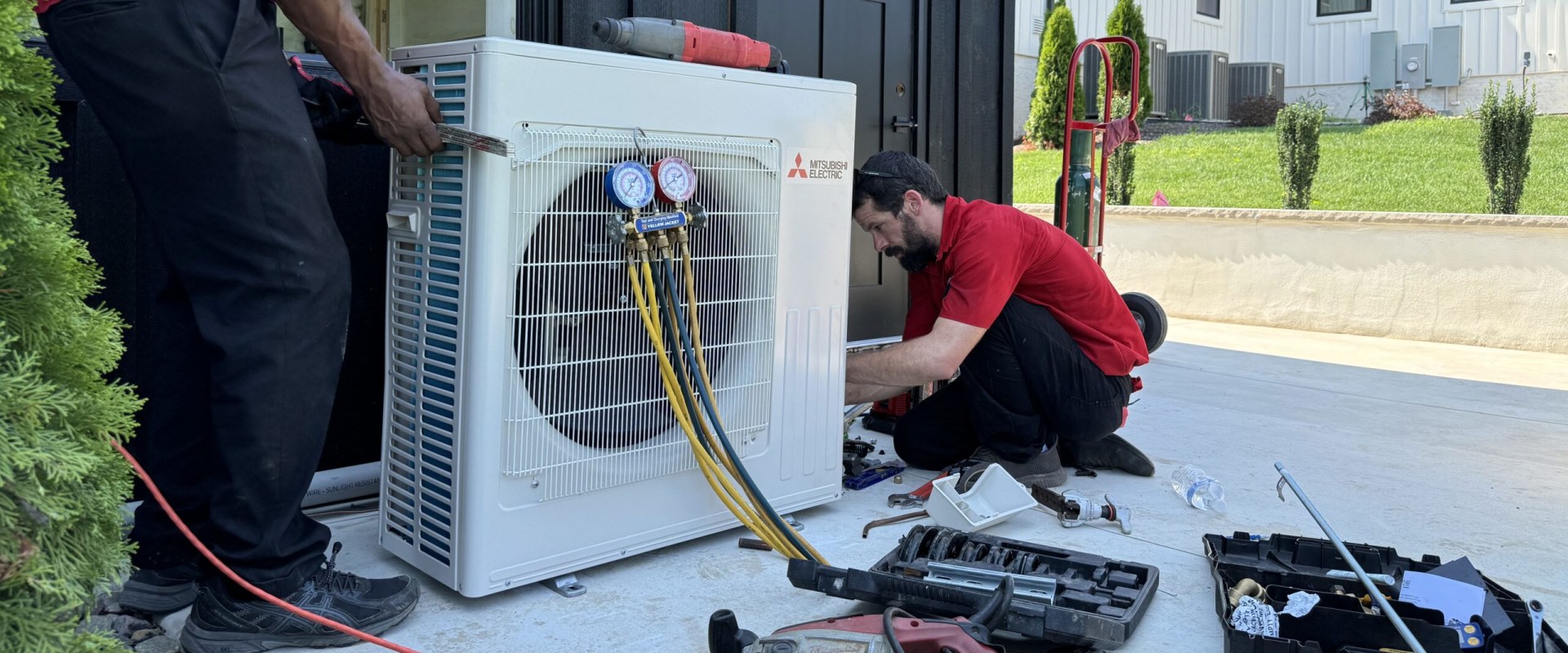
We've responded to enough post-storm calls across Deltona to know the damage isn't always visible at first. A system that starts up after a storm isn't necessarily running safely. The issues we find most often aren't dramatic — they're quiet:
Debris packed into condenser coils that forces the system to work harder than it should
Electrical connections compromised by moisture that show up as failures weeks later
Refrigerant lines shifted by wind pressure that reduce efficiency without triggering an obvious warning
What this page covers:
What to inspect before restarting your system after a Deltona storm
Which post-storm issues require a licensed technician — and which don't
Why Florida's storm patterns create risks that standard maintenance checklists aren't written for
What to document for warranty protection and homeowner's insurance purposes
Deltona's storm season isn't a rare disruption — it's an annual reality. After years of post-storm service calls in this market, the pattern is consistent: the homeowners who avoid costly repairs aren't the ones who got lucky. They're the ones who knew what to check, acted quickly, and relied on top HVAC system maintenance near Deltona FL rather than waiting for a manageable issue to become a system failure.
TL;DR Quick Answers
top HVAC system maintenance near Deltona FL
After a major storm, Deltona HVAC systems need immediate attention — even if they appear undamaged. Here's what to know:
First step: Visual inspection of the outdoor unit before restarting — never power on a system that shows signs of debris intrusion, moisture damage, or physical impact
What to inspect: Condenser coils, electrical components, refrigerant line sets, condenser fins, and ground-level flooding around the outdoor unit
Who to call: A Florida state-licensed HVAC technician — verify at DBPR before authorizing any post-storm inspection or repair work
What to document: Photographs of all visible damage + written technician inspection report + insurance provider contact — all before repairs begin
Biggest local risk: Deltona's six-month storm season means HVAC systems face repeated weather stress events — post-storm maintenance is routine homeownership here, not an emergency response
Contractor warning: Post-storm fraud spikes after every Florida weather event — unsolicited offers, inflated estimates, and large upfront deposits are the patterns Florida's AG office flags most frequently
Bottom line: The homeowners who come through post-storm recovery in the best financial position aren't the ones who moved fastest — they're the ones who inspected first, documented thoroughly, and hired right
Top Takeaways
Never restart your HVAC system immediately after a major storm
A system that powers on isn't necessarily running safely
The damage that matters most in Deltona is rarely visible from the outside
When in doubt — don't start it. Call a licensed HVAC technician first
The first 24–48 hours determine your recovery outcome
Inspect before restarting
Document before repairing
Verify credentials before hiring
Homeowners who follow this order consistently pay less and recover faster
Deltona's storm season runs six months every year — June 1 through November 30
HVAC systems here face repeated weather stress, not isolated incidents
Post-storm maintenance isn't emergency preparedness — it's routine homeownership
Post-storm contractor fraud spikes after every major Florida weather event
Always verify Florida state license at DBPR before authorizing any work
Unlicensed inspections and inflated repair estimates are the most common complaints the AG's office receives after storms
Documentation turns storm damage into a covered claim
Photograph all visible damage before repairs begin
Secure a written inspection report from a licensed technician
Contact your insurance provider before authorizing any work
The instinct after a storm passes is to get the house cool again as fast as possible. We understand that — Deltona heat is unforgiving. But restarting a system before a basic inspection is one of the most common mistakes we see after major weather events.
Before you touch the thermostat:
Walk the exterior and visually inspect the outdoor condenser unit
Check for visible debris, standing water, or physical damage to the cabinet
Look for downed power lines or electrical damage near the unit
Confirm the disconnect box near the condenser wasn't compromised by water or impact
If anything looks abnormal — don't start the system. Call a licensed technician first.
What Storm Damage Actually Looks Like on a Deltona HVAC System
Most post-storm damage isn't a collapsed unit or a visibly destroyed system. It's subtler than that. After years of post-storm service calls in this market, here's what we find most often:
Debris-packed condenser coils: Leaves, dirt, and storm debris driven into the coil fins restrict airflow and force the system to work harder — silently inflating energy bills and accelerating wear
Moisture in electrical components: Flooded disconnect boxes and compromised wiring don't always fail immediately — they create intermittent issues that are harder to diagnose and more expensive to repair
Shifted or damaged refrigerant lines: High winds can move line sets enough to stress connections — leading to slow refrigerant leaks that reduce cooling capacity over weeks
Bent condenser fins: Even moderate wind-driven debris can bend the aluminum fins on a condenser coil — reducing efficiency without any obvious external sign of damage
Flooded air handler or indoor unit: In severe flooding events, water intrusion into the indoor unit can damage blower motors, electrical boards, and insulation — none of which are immediately visible after the water recedes
What You Can Safely Do Yourself After a Storm
Not every post-storm task requires a technician. Here's what Deltona homeowners can handle independently:
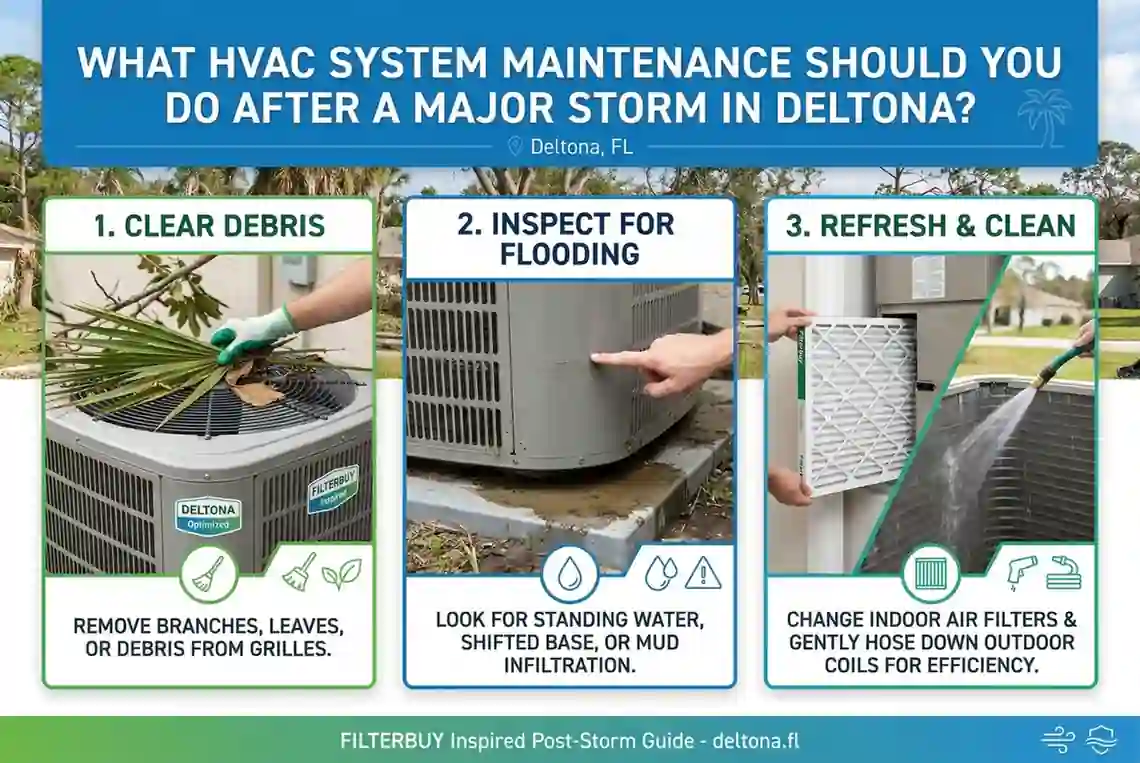
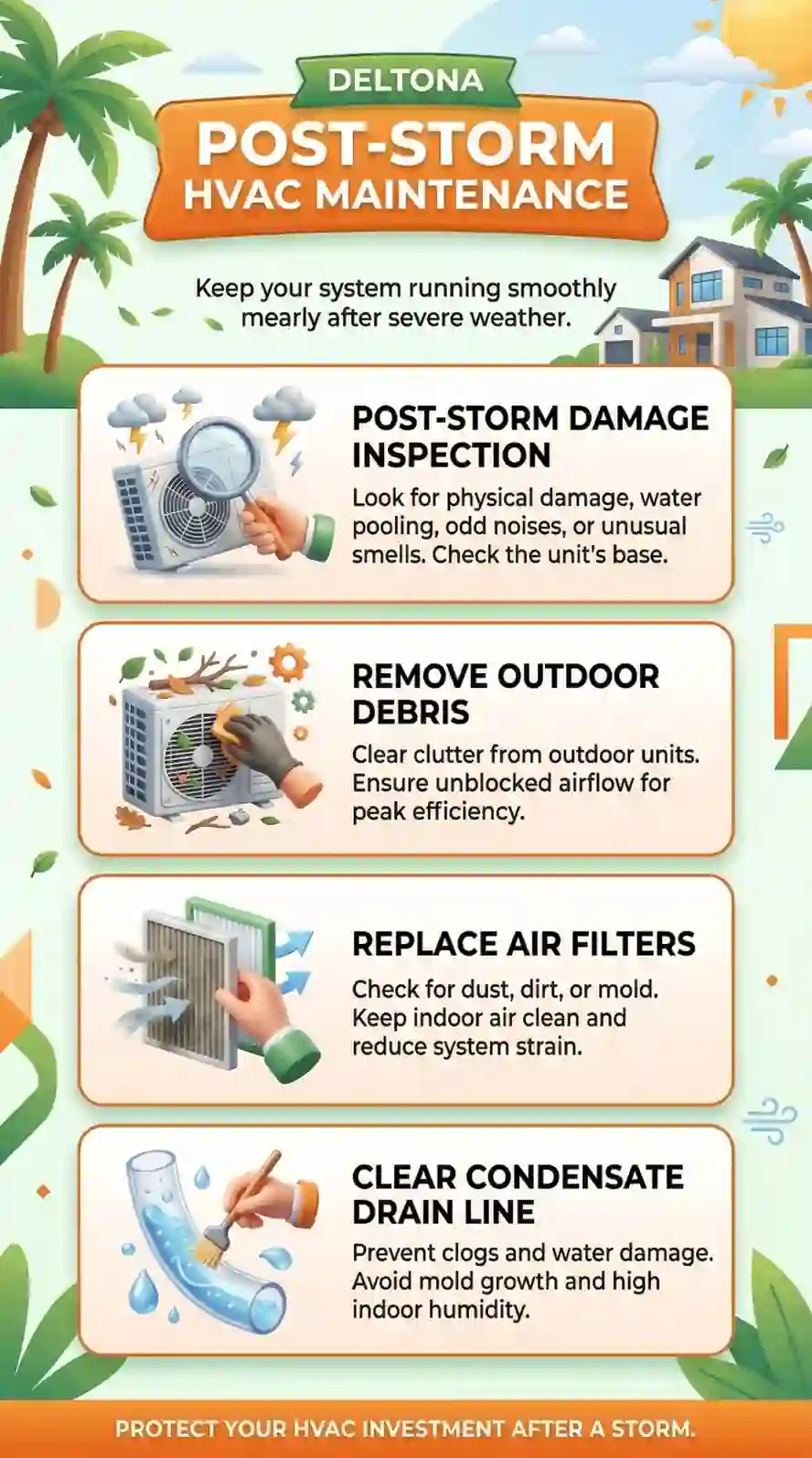
Clear visible debris from around and on top of the outdoor condenser unit
Rinse the condenser coil gently with a garden hose — top to bottom, not bottom to top — to flush out surface debris
Check and replace the air filter — storm events pull significantly more airborne particles through the system
Reset the circuit breaker only after a full visual inspection confirms no visible damage
Check condensate drain lines for blockages — storm debris and wind-driven dirt are common clog contributors
Stop at anything that involves electrical components, refrigerant lines, or internal system access. Those require a licensed Florida HVAC technician.
When to Call a Licensed Technician Immediately
Some post-storm conditions aren't judgment calls. Call a licensed technician before restarting the system if:
The outdoor unit was submerged or partially flooded
You hear unusual sounds — grinding, rattling, or hissing — on startup
The system runs but isn't cooling effectively within the first hour
You find physical damage to refrigerant lines, electrical wiring, or the condenser cabinet
The disconnect box shows signs of water intrusion or burn marks
Your circuit breaker trips immediately after restarting the system
In our experience, the homeowners who call us early after a storm consistently pay less than the ones who wait. A post-storm inspection from a top HVAC maintenance service costs a fraction of what deferred storm damage repairs run after weeks of undetected operation.
Why Deltona's Storm Pattern Creates Unique HVAC Risks
Standard post-storm HVAC guidance isn't written for Central Florida. Deltona's specific storm profile creates risks that generic checklists don't account for:
Hurricane season runs June through November — six months of elevated storm risk means HVAC systems here face repeated weather stress events, not isolated incidents
High pre-storm humidity means systems are often running at maximum demand right before a storm hits — which increases the stress on components that then sit idle during the event
Flooding risk in low-lying areas is higher than national averages account for — Volusia County's geography means standing water around outdoor units is a realistic post-storm scenario, not an edge case
Wind-driven rain in Florida storms penetrates outdoor equipment differently than in drier climates — moisture intrusion into electrical components is more common here than standard maintenance guidance anticipates
What to Document for Insurance and Warranty Purposes
Post-storm HVAC damage is often covered — but only if it's documented correctly. Before any repairs begin:
Photograph all visible damage to the outdoor unit, line sets, and electrical components
Note the date and storm event — cross-reference with National Weather Service records if needed
Request a written inspection report from your licensed technician before authorizing repairs
Check your warranty terms — most manufacturers require licensed technician documentation for storm-related warranty claims
Contact your homeowner's insurance provider before repairs begin — unauthorized repairs can complicate or void storm damage claims
The documentation step is one we have to remind homeowners about regularly. In the urgency to get the system running again, paperwork feels secondary. In our experience, it's the step that determines whether storm damage costs you hundreds or thousands of dollars out of pocket.
"After every major storm season in Deltona, we see the same two groups of homeowners. The first group called within 24 hours of the storm passing — they prioritized professional HVAC maintenance and wanted an inspection before restarting their system. Most of them were back up and running the same day with nothing more than a coil cleaning and a filter change. The second group waited. They restarted the system, assumed it was fine, and called two to six weeks later when something failed. By that point, what started as moisture in an electrical connection or a slow refrigerant leak had become a compressor issue or a failed control board. The storm didn't cost them more — waiting did. In Deltona's climate, professional HVAC maintenance after a major weather event protects the system before small issues turn into expensive failures."
Essential Resources
We want every Deltona homeowner to feel confident making decisions about their HVAC system after a major storm — not pressured, not rushed, and never in the dark. These are the resources we'd put in front of any neighbor trying to figure out their next step.
1. The Federal Standard Every Deltona HVAC Technician Should Be Working From
Before you let anyone inspect or service your system after a storm, know what a qualified technician is actually supposed to do. The DOE's maintenance guide covers every step a proper service visit should include — so you can tell the difference between a thorough inspection and a technician who showed up, looked around, and handed you a repair estimate. U.S. Department of Energy — Air Conditioner Maintenance
2. The Checklist That Tells You Whether You Got a Real Maintenance Visit
This is the federal benchmark for what a complete HVAC service visit should cover — coil cleaning, refrigerant checks, electrical connections, airflow verification, and more. If your technician didn't work through these steps, the visit wasn't complete. We share this with homeowners because an informed customer is the best protection against substandard work. ENERGY STAR — Maintenance Checklist
3. FEMA's Official Guidance for HVAC Systems After a Flood or Storm
This is the resource we point Deltona homeowners to when a storm has been severe enough to raise questions about whether a system is safe to restart. FEMA's post-flood recovery guide addresses mechanical systems directly — covering what to inspect, what to avoid, and when a professional needs to be involved before the system comes back on. FEMA — Repairing Your Flooded Home
4. The First Place to Check When a Storm Has Passed Through Deltona
Before assessing your system, know what it just went through. The NWS office serving Volusia County is the most reliable source for storm tracking, hurricane updates, and severe weather data specific to the Deltona area — and that documentation matters if you end up filing an insurance claim for storm-related damage. National Weather Service — Melbourne, FL
5. Florida's Official Recovery Resource for Homeowners After a Major Storm
The Florida Division of Emergency Management provides guidance that goes beyond generic storm prep — covering how to protect and assess home mechanical systems before and after major weather events specific to Volusia County. If a hurricane or tropical storm has moved through Deltona, this is where the state's official recovery guidance lives. Florida Division of Emergency Management — Hurricane Preparedness
6. Two Minutes That Could Save You From a Post-Storm Contractor Nightmare
Post-storm periods are when unlicensed HVAC contractors are most active in Florida communities like Deltona. Florida requires every HVAC technician to hold a valid state license — and this tool confirms it in minutes. Don't skip this step when someone shows up at your door offering a post-storm inspection deal that sounds too good to be true. Florida DBPR — License Verification
7. Know Your Rights Before a Post-Storm Contractor Knocks on Your Door
Price gouging, unlicensed repairs, and deposit scams spike after every major storm event in Florida — and Deltona is no exception. The Florida AG's office documents exactly what these schemes look like, what your rights are as a homeowner, and how to report a contractor who crosses the line. Read this before you sign anything. Florida Attorney General — Consumer Protection for Contractors
Supporting Statistics
We've worked through enough post-storm seasons in Deltona to know these numbers aren't abstract. They reflect what we see in this community every time a major weather event moves through Volusia County.
The Atlantic hurricane season produces an average of 14 named storms, 7 hurricanes, and 3 major hurricanes — running June 1 through November 30 every year. NOAA National Hurricane Center — Tropical Cyclone Climatology
That six-month window is something Deltona homeowners live inside. What the statistic doesn't capture — but we see on the service side every season:
Storms that don't make national headlines still pack condenser coils with debris
Moisture intrusion from tropical storms causes the same electrical failures as named hurricanes
Wind-driven particulates back up drain lines whether or not a storm gets a name
The damage threshold is lower than most homeowners expect
After years of post-storm calls in this market, we've stopped distinguishing between "major" and "minor" storms when recommending a post-event inspection. The HVAC system doesn't make that distinction either.
Florida's price gouging law carries civil penalties of $1,000 per violation — up to $25,000 for multiple violations in a single 24-hour period. Florida Attorney General — Price Gouging
Florida enacted this law after Hurricane Andrew in 1992 because post-storm contractor fraud was already an established pattern. What we've seen in Deltona firsthand after significant storm events:
Unlicensed contractors approach homeowners with inspection offers that seem reasonable
The repair estimate that follows rarely is
By the time something feels wrong, a contract is signed or a deposit is paid
Knowing this law exists — and that violations carry real financial consequences — is one of the most practical things we share with Deltona neighbors before storm season starts.
FEMA delivered more than $11 billion in assistance to Florida survivors of Hurricanes Helene and Milton — including over $1.7 billion in direct grants for uninsured losses and home repairs. FEMA — Hurricanes Helene and Milton Fact Sheets
These statistics underscore the impоrtаnсе оf HVAC tесhnісіаns in Deltona, where trained professionals help identify storm-related system damage early and ensure HVAC systems continue operating safely and efficiently after severe weather.
Final Thoughts
A major storm in Deltona doesn't just test your roof and windows. It tests every mechanical system in your home — and your HVAC system is the one that gets back to work first, under the most demand, in the worst conditions.
After years in this market, our opinion is clear: what separates homeowners who come through post-storm recovery well from those who don't rarely comes down to storm severity. It almost always comes down to what happened in the first 24 to 48 hours after the storm passed.
Homeowners who called us early shared the same profile:
Didn't restart the system before completing a visual inspection
Documented damage before calling anyone else
Verified credentials before letting anyone touch their equipment
Treated the post-storm inspection as part of recovery — not an optional add-on
Homeowners who called us weeks later shared a different one:
Restarted the system and assumed it was fine
Discovered the problem when something failed
Almost always called during peak summer heat — the worst possible time
Our honest opinion after years in this market:
The post-storm inspection isn't the most expensive part of storm recovery. Skipping it consistently is. Here's what we see when homeowners wait:
Moisture in an electrical connection becomes a failed control board
Debris packed into a condenser coil becomes a compressor running at reduced capacity for months
A slow refrigerant leak becomes a system that can't cool the house when temperatures hit 95 degrees in August
None of those outcomes are inevitable. Every one is preventable — with an inspection that costs a fraction of what the repair will.
Florida's storm season runs six months every year. In Deltona, severe weather isn't a question of if — it's a question of when. The families who handle post-storm recovery best aren't the ones who got lucky. They're the ones who knew exactly what to do and relied on a trusted HVAC solution before the next storm formed in the Gulf.
That preparation starts here. Because in Deltona, June 1 comes every year.
FAQ on Top HVAC System Maintenance Near Deltona, FL
Q: Should I run my HVAC system immediately after a major storm in Deltona, FL?
A: No. This decision determines what post-storm recovery costs. Before restarting, check for:
Visible debris, standing water, or physical damage to the outdoor unit
Moisture intrusion in the disconnect box or electrical components
Physical damage to the condenser cabinet or refrigerant lines
Two things we know from post-storm service calls in this market:
A system that starts up after a storm isn't necessarily running safely
Homeowners who restart a compromised system almost always pay more than those who called first
When something looks wrong — don't start it. Call a licensed technician first.
Q: What storm damage should I look for on my HVAC system after a major weather event in Deltona?
A: The damage we find most often after Deltona storms isn't dramatic — it's quiet. Inspect these five areas before restarting:
Condenser coils — debris packing forces the system to overwork without any visible warning
Electrical components — moisture intrusion doesn't fail immediately; it shows up as intermittent issues weeks later
Condenser fins — wind-driven debris bends fins and reduces efficiency silently
Refrigerant line sets — storm shifting causes slow leaks that reduce cooling capacity over weeks
Ground around outdoor unit — standing water requires professional assessment before restart
If any of these conditions are present — stop. Call a licensed Florida HVAC technician before the system comes back on.
Q: How do I find a trustworthy HVAC technician for post-storm repairs near Deltona, FL?
A: Start with Florida's DBPR license verification tool. Post-storm periods are when unlicensed contractors are most active in Deltona. Beyond licensing, look for:
Experience in Central Florida's climate specifically — not just general HVAC experience
Itemized pricing confirmed before any work begins
Written inspection report delivered before repair recommendations are made
No pressure to authorize repairs on the spot
The post-storm contractor pattern Florida's AG office flags after every storm:
Unsolicited inspection offers
Inflated repair estimates
Large upfront deposit requests
A technician worth trusting shows you what they found, gives you evidence, and gives you time to decide.
Q: What should I document after storm damage to my HVAC system in Deltona, FL?
A: Documentation turns storm damage into a covered claim. Do this before any repair work begins:
Photograph all visible damage — outdoor unit, line sets, electrical components
Note the date and storm event — cross-reference NWS Volusia County records if needed
Get a written inspection report from a licensed technician before authorizing repairs
Review warranty terms — most manufacturers require licensed documentation for storm claims
Call your insurance provider before work begins — unauthorized repairs can void storm damage claims
The homeowners who recovered the most financially from post-storm repairs shared one pattern: they documented first and repaired second.
Q: How does Deltona's storm season specifically affect HVAC system maintenance needs?
A: More than most homeowners realize. After years of post-storm calls in this market, here's what makes Deltona different from national maintenance guidelines:
6 months of active storm risk — June 1 through November 30, every year
Pre-storm humidity pushes systems to maximum demand before shutdown — components restart under the same stress immediately after
Wind-driven rain penetrates outdoor equipment more aggressively in Florida than national guidelines anticipate
Volusia County geography creates localized flooding risk that national averages don't account for
Bottom line: a severe thunderstorm in Deltona deserves the same post-event inspection as a named tropical storm. After years of service calls in this market — we've found the same damage from both.
After severe weather moves through Central Florida, homeowners often need to check several system components before returning their HVAC equipment to normal operation. The article What HVAC System Maintenance Should You Do After a Major Storm in Deltona? outlines the essential inspection steps, including clearing debris from outdoor units, checking electrical connections, and verifying that airflow and filtration haven’t been compromised. Storms frequently push dust, leaves, and moisture into HVAC systems, which is why replacing filters can be one of the first practical steps after an inspection. Options such as 10x24x1 pleated furnace air filters help restore proper airflow after debris buildup, while 13x21.5x1 MERV 8 HVAC AC furnace air filters support balanced filtration to keep contaminants from circulating through the system. Homeowners can also consider replacement HVAC furnace air filters to maintain system performance between professional service visits. Combined with a careful post-storm inspection, proper filtration helps Deltona homeowners restore system efficiency and prevent minor storm-related issues from developing into costly repairs.